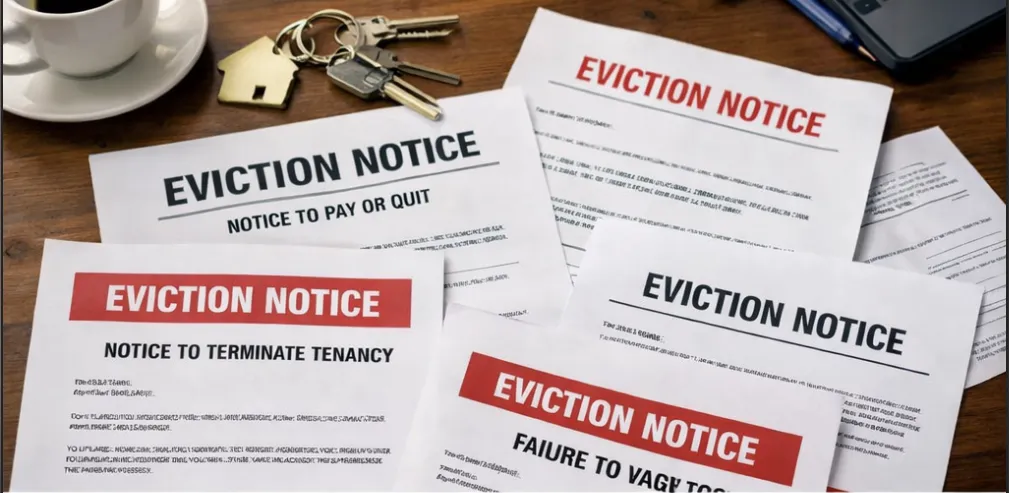
What Happens If You Ignore an Eviction Notice?
Written by the HelpForEviction editorial team · Last updated March 2026
This article cites HUD data, state court self-help resources, and eviction research. It does not constitute legal advice.
What Happens If You Ignore an Eviction Notice?
The short answer:
If you ignore an eviction notice, your landlord can file a formal eviction lawsuit. Once you are served with court papers, you typically have 3 to 5 business days to file a written response — depending on your state. Miss that deadline and the court enters a default judgment against you automatically. You lose, your defenses disappear, and a lockout date is set. This happens to roughly 40% of renters facing eviction — not because they had no case, but because they never responded.
That outcome is not inevitable. The eviction process has multiple stages — and at almost every stage, you have an opportunity to respond, defend yourself, or negotiate. But those opportunities close fast, and they close in order. Once a stage passes, you cannot go back.
Here is exactly what happens, when it happens, and what you can still do at each point.
Not sure how much time you have left?
HelpForEviction calculates your exact deadline based on your notice type, serve date, and state — so you know precisely where you stand right now.
Free to start. No credit card required.
Visit HelpForEviction.com to calculate your deadline.
The Eviction Timeline When You Don’t Respond
This is what the process looks like from the moment a notice is served to the moment a sheriff arrives — assuming the tenant does nothing at each stage.
When What happens Day 1–3 (or 1–30) Notice period runs. You can still pay, fix the violation, or negotiate. Day after notice expires Landlord can file an Unlawful Detainer lawsuit at the courthouse. 3–7 days later You are served the UD summons and complaint. 5 business days after service DEADLINE: File a written response with the court or lose by default. ~20 days after response filed Hearing scheduled. This is where you present your defense. After judgment (if you lose) Writ of Possession issued. Lockout date set by the sheriff.
The table above assumes you take no action at any point. In reality, most renters have options at the notice stage, at the UD response stage, and even at the hearing. The default judgment is what happens when those windows close unopened.
A default judgment doesn’t mean you had no defense. It means your defense never got heard.
What a Default Judgment Actually Does to You
A default judgment in an eviction case is not just a loss — it has consequences that follow you after you leave the unit.
The eviction appears on your rental history. Tenant screening companies report UD filings and judgments, and many landlords automatically reject applicants with eviction records — even dismissed cases, and certainly default judgments.
Your credit can be affected. If the judgment includes unpaid rent or damages, it may appear as a civil judgment on your credit report.
You lose the right to negotiate. Before a judgment, you can often negotiate a move-out agreement, a payment plan, or a dismissed case in exchange for vacating. After a default judgment, that leverage is gone.
The sheriff enforces the lockout. A Writ of Possession gives the landlord the right to have law enforcement remove you and your belongings from the property on a specific date.
None of this is reversible through inaction. The only way to avoid a default judgment is to respond — in writing, to the court, before the deadline.
You still have time — if you move now.
HelpForEviction’s document checklist and step-by-step response guide walk you through exactly what to file, what to gather, and what to say — before the deadline closes.
Free to start. No credit card required.
Visit HelpForEviction.com to get started.
More Questions About Ignoring an Eviction Notice
✎ Editor note: Add FAQPage schema markup to every Q&A block in this section before publishing. Each question maps directly to a schema Question/Answer pair and targets a People Also Ask result.
Can I be evicted immediately if I ignore the notice?
No. Ignoring the initial notice does not result in an immediate lockout. Your landlord must file a lawsuit, serve you with court papers, wait for the response deadline to pass, obtain a judgment, and then get a Writ of Possession before law enforcement can remove you. The entire process typically takes 3 to 8 weeks depending on your state and local court schedule. That said, the process moves fast once it starts — and each stage that passes without a response makes the next one harder to stop.
What if I can’t afford to pay what I owe?
Inability to pay is not, on its own, a legal defense to eviction. But it doesn’t mean you have no options. Many states have emergency rental assistance programs still operating in 2026. Some landlords will negotiate a payment plan rather than go through the cost and delay of a full eviction proceeding. And if your landlord accepted any payment after sending the notice, that may reset the clock in some states. The key is to respond and communicate — not ignore. Silence almost always produces the worst outcome.
Will ignoring the notice affect my credit?
The eviction notice itself does not appear on your credit report. But if your landlord obtains a judgment against you — which is what happens when you don’t respond — that civil judgment can appear on your credit report and remain there for up to seven years. Unpaid rent sent to collections also affects your credit. Responding to the eviction and reaching any kind of resolution — even a negotiated move-out — is almost always better for your credit than a default judgment.
Can I still fight the eviction after a default judgment?
In limited circumstances, yes. Most states allow you to file a motion to set aside a default judgment if you can show you had a valid reason for not responding — improper service, medical emergency, or a mistake in the court’s process. But this is difficult, time-sensitive, and not guaranteed. The window to file a motion to set aside is typically very short, and courts are not required to grant them. Preventing the default judgment is always easier than reversing it.
Does HelpForEviction provide legal advice?
No. HelpForEviction provides deadline tracking, document organization, educational content, and step-by-step process guidance. This is not legal advice and does not substitute for a licensed attorney. If your situation involves retaliation, discrimination, habitability disputes, or a judgment has already been entered against you, connecting with a legal aid organization in your state is strongly recommended.
The One Thing That Changes Everything
The renters who avoid the worst outcomes have almost nothing else in common — different states, different notice types, different amounts owed, different lease situations. But they share one thing: they responded.
Not perfectly. Not always with a lawyer. Not always with the right paperwork. But they showed up — they filed something, they appeared, they communicated. That single act keeps options open. Ignoring the notice closes them, one by one, until there are none left.
If you have a notice in your hand right now, the first step is to find out exactly how much time you have. Everything else follows from that number.
Find out how much time you have right now.
Enter your notice type and serve date. HelpForEviction calculates your exact response deadline, builds your document checklist, and walks you through what to do next — step by step.
Free to start. No credit card required.
Sources
HUD: Eviction Protection Grant Program outcomes data, January 2025
Princeton Eviction Lab: Eviction tracking and default judgment research — evictionlab.org
lawhelp.org — state-by-state tenant rights resources and legal aid finder
California Courts Self-Help Center: Landlord/Tenant — courts.ca.gov/selfhelp
National Housing Law Project: Tenant protections and eviction defense resources — nhlp.org
HelpForEviction.com · FAQ Article
This article does not constitute legal advice. For your specific situation, consult a licensed attorney in your state.
